Manual for DV-989AVi-G / DV-989AVi-S

Manual for DV-989AVi-G / DV-989AVi-S

Brand: PIONEER

Category: DVD Player

Document Type: Manual

Language: EN

Uploaded: Nov. 21, 2025, 8:10 p.m.

Warranty Information

This product is for general household purposes and repairs during the warranty period may be charged for use outside of these purposes.

  • Connecting Components: Use provided cables (HDMI, i.LINK, RCA, S-Video) to connect the player to a TV or AV receiver. Ensure all devices are off before connecting.
  • Powering On: Connect the power cord and plug into an outlet. Press STANDBY/ON.
  • Disc Playback: Insert a disc and press PLAY. Use playback controls (PLAY, PAUSE, STOP, SKIP) and on-screen menus for navigation.
  • Settings: Access the Setup Navigator to configure TV system, audio, video, and other preferences.
  • Troubleshooting: Refer to the dedicated section for common issues like no sound, no picture, or playback errors.

Troubleshooting and error codes

GeneralRemedy
The disc won't play or is automatically ejected after loading.
  • Make sure the disc is free from dirt and dust and is not damaged (see Taking care of your player and discs on page 76).
  • Make sure the disc is loaded with the label side face-up and aligned properly in the disc tray guide.
  • Incompatible region number: If the region number on a DVD-Video disc does not match the number on the player, the disc cannot be used (see DVD-Video regions on page 11).
  • Condensation inside the player: Allow time for condensation to evaporate. Avoid using the player near an air-conditioning unit.
  • The disc may have been illegally copied.
DVD-Audio playback stops.
  • Press, then start playback again (►)
Picture playback stops and the operation buttons cannot be used.
  • Switch the power off once, unplug from the wall socket, then plug back in and switch on again by pressing & STANDBY/ON to switch the player on.
New settings made in the Setup screen menus while a disc is playing are ineffective.
  • Some settings can be changed while a disc is playing, but are not effective until the disc is stopped then restarted: Press then start playback again (►)
Settings are canceled.
  • When the power is cut due to power failure or by unplugging the power cord during operation, settings will be canceled. See Moving the player on page 77 for proper shutdown instructions.
DVD/CD/Video CD/Super VCD playerRemedy
The remote control doesn't seem to work.
  • The CONTROL IN jack on the rear panel is connected: Point the remote control at the connected component to control this player.
  • The remote control is too far from the player, or the angle with the remote sensor is too wide: Use the remote within its operating range (see Using the remote control on page 8).
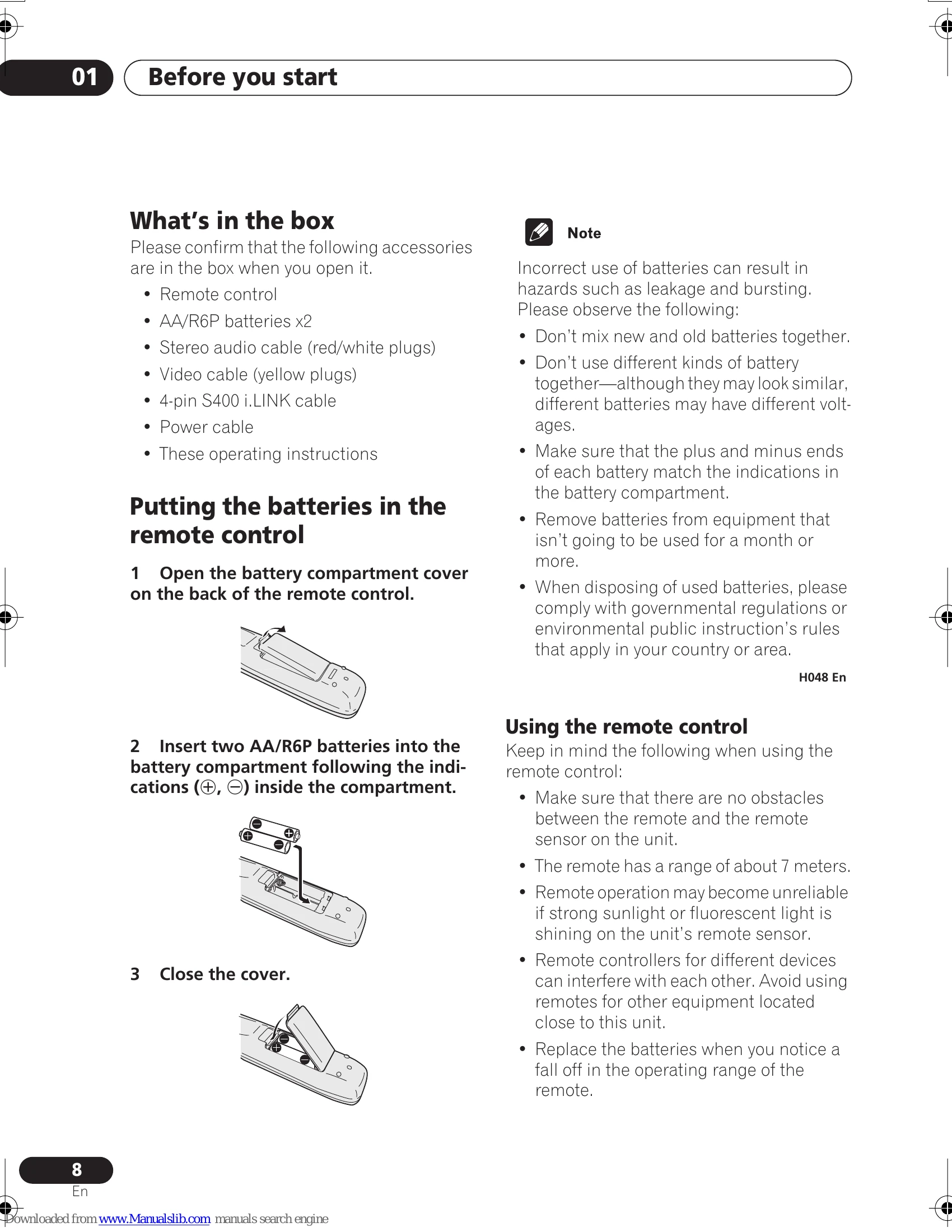
  • The batteries are exhausted: Put in new ones (see Putting the batteries in the remote control on page 8).
No picture/No color.
  • Check that the PURE AUDIO indicator is not lit. If it is, press the PURE AUDIO button (See also Front panel on page 23).
  • Incorrect video connections: Check that connections are correct and that plugs are inserted fully. Also check the video cable for damage.
  • TV/monitor or AV amplifier settings are incorrect: Check the instruction manual of the connected equipment.
  • The video output is set to progressive but your TV/monitor is not compatible with progressive scan: Press the PROGRESSIVE button on the front panel to set to interlace (the indicator above the button should not be lit) (see About progressive scan video on page 24).
  • The TV Screen setting in the Initial Settings menu is incorrect. See TV Screen on page 60 for how to set it correctly for your TV/monitor.
  • If your TV/monitor is connected using an S-video cable, try changing the S-Video Out setting (see S-Video Out on page 61).
Screen is stretched or aspect does not change.
  • The TV Screen setting in the Initial Settings menu is incorrect. See TV Screen on page 60 for how to set it correctly for your TV/monitor.
  • If your TV/monitor is connected using an S-video cable, try changing the S-Video Out setting (see S-Video Out on page 61).
Picture disturbance during playback or dark.
  • This player is compatible with Macro-Vision System copy guard. Some discs include a copy prevention signal, and when this type of disc is played back, stripes etc., may appear on some sections of the picture depending on the TV. This is not a malfunction.
  • Due to the player's copy protection circuits, connection of this device through a VCR or an AV selector may prevent recording or cause picture problems. This is not a malfunction.
  • The TV system may be set inappropriately. See Setting the TV System on page 28.
ProblemRemedy
No audio, or audio is distorted.
  • No audio is output during slow motion playback or when scanning discs other than audio CDs
  • Some DVD discs do not output digital audio: Switch your amplifier to the player's analog outputs.
  • Check that the disc is free from dust and dirt, and that it is not damaged (Taking care of your player and discs on page 76).
  • Check that all interconnects are firmly inserted.
  • Check that the plugs and terminals are free of dirt, oxide, etc. and clean if necessary. Also check the cable for damage.
  • Make sure the player's output is not connected to the amplifier's phono (turntable) inputs.
  • Check your amplifier/receiver's settings (volume, input function, speaker settings, etc.).
The analog audio is OK, but there appears to be no optical/coaxial digital audio signal.
  • Make sure that the Digital Out setting is set to On (see Digital Out on page 58).
  • Check that the Dolby Digital, DTS and MPEG Out settings (see Digital Audio Out settings on page 58) are suitable for your amplifier/receiver-check the instruction manual that came with your amplifier/receiver.
  • SACDs and some DVD-Audio discs do not output digital audio. Listen through the player's analog audio outputs.
  • Check that the PURE AUDIO indicator is not lit. If it is, press the PURE AUDIO button (See also Front panel on page 23).
Noticeable difference in DVD and CD volume.
  • This is due to differences in the audio format and is not a malfunction.
Cannot play multi-channel audio.
  • Make sure that Audio Output Mode is set to 5.1 Channel (see Audio Output Mode on page 71).
  • Check that the Dolby Digital, DTS and MPEG Out settings (see Digital Audio Out settings on page 58) are suitable for your amplifier/receiver-check the instruction manual that came with your amplifier/receiver.
  • DVD-Audio and SACDs do not output multichannel digital audio. Listen through the player's analog outputs.
  • Check that the settings in the Speaker Installation on page 71 are correct.
  • Check the audio options available from the disc menu.
Cannot listen to high-sampling rate audio through the optical/coaxial digital output.
  • Make sure that Linear PCM Out is set to Down Sample Off (see Linear PCM Out on page 59).
  • As a copy-protection measure, some DVDs do not output 96kHz audio. In this case, even if set to Down Sample Off, the player automatically outputs the audio at 48 kHz. This is not a malfunction.
Cannot output 192kHz or 176.4kHz digital audio from optical/coaxial output.
  • The player does not output digital audio from the optical/coaxial jacks at these sampling rates. The digital output is automatically downsampled.
Cannot output 96kHz or 88.2kHz digital audio from optical/coaxial output.
  • Check that Linear PCM Out is set to Down Sample Off (see Linear PCM Out on page 59).
  • Some discs are digital copy protected and do not output high sampling rate digital audio. In this case the output is automatically downsampled.
No DTS audio output from optical/coaxial output.
  • If this unit is connected to a non-DTS compatible amplifier or decoder using a digital audio cable, set DTS Out to DTS > PCM. If you do not do this, noise will be output when you play a DTS disc.
  • If this unit is connected to a DTS-compatible amplifier or decoder using a digital audio cable, check the amplifier settings, and that the cable is properly connected.
Audio mix does not sound right or sounds incomplete (for example, inaudible dialog).
  • Make sure that Audio Output Mode is set to 2 Channel if you've connected to the stereo inputs on your amplifier or TV (see Audio Output Mode on page 71).
Disc containing the MP3 tracks won't play.
  • This player is compatible with multi-session discs, but only plays sessions that are closed.
  • If the message UNPLAYABLE is displayed when you try to play a disc/track, check the audio file formats (Compressed Audio Compatibility on page 10).
Can't hear effect of TruSurround
  • TruSurround does not work with CD, MP3, DVD-Audio, SACD or 96kHz linear PCM DVD.
  • The TruSurround effect is only output through the AUDIO OUT (2ch) analog audio outputs.
  • Make sure that Audio Output Mode is set to 2 Channel (see Audio Output Mode on page 71).
  • The effectiveness of TruSurround varies with the disc.
The audio recorded on a Super VCD disc is not output properly.
  • If the audio is switched to [2] when playing a Super VCD that contains only one stereo soundtrack, there may be no sound at all. Press AUDIO to change the soundtrack.
ProblemRemedy
No HDMI audio output.
  • This unit has been designed to be compliant with HDMI (High Definition Multimedia Interface) Version 1.1. Depending on the component you have connected, unreliable signal transfers may result.
  • If the front panel HDMI indicator is lit: - You won't hear any sound from the HDMI output if the source component is only DVI/HDCP-compatible. - It is not possible to output SACD sources from the HDMI connection.
  • If the front panel HDMI indicator is unlit then: Make sure that you've selected this player as the HDMI input in the settings for the component you're using. You may need to refer to the instruction manual of the component to do this. Check that the HDMI cable is connected properly and that the cable isn't damaged. Check that components connected using the HDMI interface are switched on and HDMI compatible. (An HDMI connection can only be made with components compatible with both DVI and High Bandwidth Digital Content Protection (HDCP).) Check that the PURE AUDIO indicator is not lit. If it is, press the PURE AUDIO button (See also Front panel on page 23).
No HDMI video output
  • Make sure that you've selected this player as the HDMI input in the settings for the component you're using. You may need to refer to the instruction manual of the component to do this.
  • It is not possible to output SACD sources from the HDMI connection.
  • Check that the HDMI cable is connected properly and that the cable isn't damaged.
  • Check that components connected using the HDMI interface are switched on and HDMI compatible. (An HDMI connection can only be made with components compatible with both DVI and High Bandwidth Digital Content Protection (HDCP).)
  • This unit has been designed to be compliant with HDMI (High Definition Multimedia Interface) Version 1.1. Depending on the component you have connected, unreliable signal transfers may result.
  • Check that the PURE AUDIO indicator is not lit. If it is, press the PURE AUDIO button (See also Front panel on page 23).
  • Make sure the resolution on this player matches that of the component you have connected using HDMI. See HDMI Settings on page 68 to change the HDMI resolution.
No multichannel HDMI audio.
  • Make sure the Audio setting in the HDMI menu is set to Auto (see HDMI Settings on page 68 to do this).
A connected HDMI component doesn't work with this player.
  • This unit has been designed to be compliant with HDMI (High Definition Multimedia Interface) Version 1.1. Depending on the component you have connected, using a DVI connection may result in unreliable signal transfers.
Color problems occur with your monitor after changing the Video Adjust (page 55), Video Memory (page 70).
  • You can correct this by choosing an input setting on your monitor according to the setting you've selected (see the table in the note following Video Memory on page 70).
ProblemRemedy
No i.LINK audio output.
  • If the front panel i.LINK indicator is lit then: Check that your AV receiver is DTCP (Digital Transmission Copy Protection) compatible. Check that your AV receiver is compatible with the type of disc that you're trying to play (for example, SACD).
  • If the front panel i.LINK indicator is unlit then: Check that your AV receiver is set to the correct input. Check that the i.LINK cable is connected properly and that the cable isn't damaged. Use an i.LINK cable no longer than 3.5 meters. Check that components connected using the i.LINK interface are switched on and i.LINK Audio compatible. Do not connect DV format players/recorders or personal computers. Check that the i.LINK Audio Out setting is On (see Audio Out on page 74). Check that the PURE AUDIO indicator is not lit. If it is, press the PURE AUDIO button (See also Front panel on page 23).
Auto Select Play doesn't work.
  • Make sure that the receiver has been selected in the Auto Select Play on page 75.
  • Make sure that i.LINK Audio Out is set to On (see Audio Out on page 74).
  • Auto Select Play doesn't work while LINK CHECK shows in the front panel display (see i.LINK-related messages opposite).
i.LINK audio is temporarily interrupted.
  • See i.LINK related messages for possible causes of this.
No multichannel i.LINK audio.
  • For multichannel SACD playback, make sure that SACD Playback is set to Multi-ch Area (see SACD Playback on page 68).
  • For multichannel DVD-Audio playback, make sure that Audio Output Mode is set to 5.1 Channel (see Audio Output Mode on page 71).
Playback starts automatically when the input function of the AV receiver is changed to this player.
  • This is an i.LINK feature and not a malfunction.
A connected i.LINK component doesn't work with this player.
  • Depending on the connected component, this player may not work properly with it. See also the operating instructions that came with the other component.
Privacy Policy