Brand: MITSUBISHI ELECTRIC
Category: Air Conditioner
Document Type: Manual
Language: EN
Brand: MITSUBISHI ELECTRIC
Category: Air Conditioner
Document Type: Manual
Language: EN
Uploaded: Nov. 21, 2025, 7:46 p.m.
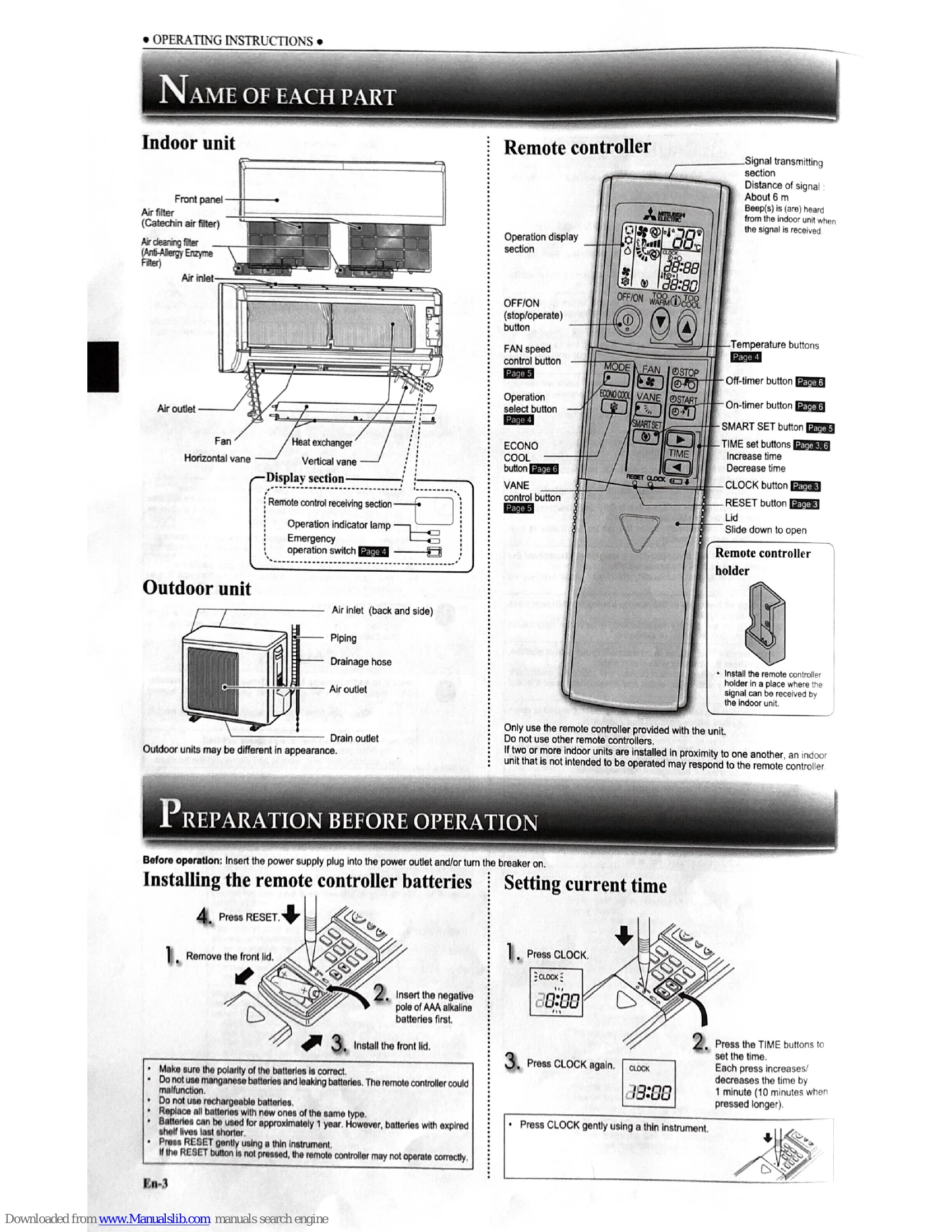
If the remote controller cannot be used, press the emergency operation switch (E.O.SW) on the indoor unit.
| Symptom | Explanation & Check points |
|---|---|
| Indoor Unit | |
| The unit cannot be operated. | Is the breaker turned on? Is the power supply plug connected? Is the ON timer set? Page 6 |
| All LED lamps on the indoor unit are blinking. | Are the horizontal vanes installed correctly? Page 7 |
| The horizontal vane does not move. | Are the horizontal vane and the vertical vane installed correctly? Page 7 Is the fan guard deformed? |
| The unit cannot be operated for about 3 minutes when restarted. | This protects the unit according to instructions from the microprocessor. Please wait. |
| Mist is discharged from the air outlet of the indoor unit. | The cool air from the unit rapidly cools moisture in the air inside the room, and it turns into mist. |
| The swing operation of the HORIZONTAL VANE is suspended for a while, then restarted. | This is for the swing operation of the HORIZONTAL VANE to be performed normally. |
| The air flow direction changes during operation. | When the unit is operated in COOL or DRY mode, if the operation continues with air blowing down for 0.5 to 1 hour, the direction of the air flow is automatically set to horizontal position to prevent water from condensing and dripping. |
| The direction of the horizontal vane cannot be adjusted with the remote controller. | These models are equipped with an auto restart function. When the main power is turned off without stopping the unit with the remote controller and is turned on again, the unit starts operation automatically in the same mode as the one set with the remote controller just before the shutoff of the main power. Refer to "Auto restart function". Page 4 |
| The unit starts operation by itself when the main power is turned on, though it isn't operated with the remote controller. | Although plastic turns yellow due to the influence of some factors such as ultraviolet light and temperature, this has no effect on the product functions. |
| The indoor unit discolors over time. | Although plastic turns yellow due to the influence of some factors such as ultraviolet light and temperature, this has no effect on the product functions. |
| Outdoor Unit | |
| The fan of the outdoor unit does not rotate even though the compressor is running. Even if the fan starts to rotate, it stops soon. | When the outside temperature is low during cooling operation, the fan operates intermittently to maintain sufficient cooling capacity. |
| Water leaks from the outdoor unit. | During COOL and DRY operations, pipe or pipe connecting sections are cooled and this causes water to condense. |
| Remote controller | |
| The display on the remote controller does not appear or it is dim. The indoor unit does not respond to the remote control signal. | Are the batteries exhausted? Page 3 Is the polarity (+, -) of the batteries correct? Page 3 Are any buttons on the remote controller of other electric appliances being pressed? |
| Does not cool | |
| The room cannot be cooled sufficiently. | Is the temperature setting appropriate? Page 4 Is the fan setting appropriate? Please change fan speed to higher setting. Page 5 Are the filters clean? Page 7 Is the fan or heat exchanger of the indoor unit clean? Page 7 Are there any obstacles blocking the air inlet or outlet of the indoor or outdoor unit? Is a window or door open? When a ventilation fan or a gas cooker is used in a room, the cooling load increases, resulting in an insufficient cooling effect. When the outside temperature is high, the cooling effect may not be sufficient. |
| Airflow | |
| The air from the indoor unit smells strange. | Are the filters clean? Page 7 Is the fan or heat exchanger of the indoor unit clean? Page 7 The unit may suck in an odor adhering to the wall, carpet, furniture, cloth, etc. and blow it out with the air. |
| Sound | |
| Cracking sound is heard. | This sound is generated by the expansion/contraction of the front panel, etc. due to change in temperature. |
| "Burbling" sound is heard. | This sound is heard when the outside air is absorbed from the drain hose by turning on the range hood or the ventilation fan, making water flowing in the drain hose to spout out. This sound is also heard when the outside air blows into the drain hose in case the outside wind is strong. |
| Mechanical sound is heard from the indoor unit. | This is the switching sound in turning on/off the fan or the compressor. |
| The sound of water flowing is heard. | This is the sound of refrigerant or condensed water flowing in the unit. |
| Hissing sound is sometimes heard. | This is the sound when the flow of refrigerant inside the unit is switched. |