Manual for Dishwasher

Manual for Dishwasher

Brand: Miele

Category: Dishwasher

Document Type: Manual

Language: EN
Uploaded: Nov. 21, 2025, 8:51 p.m.

Warranty Information

The manufacturer's warranty for this appliance is 2 years.

Using for the first time

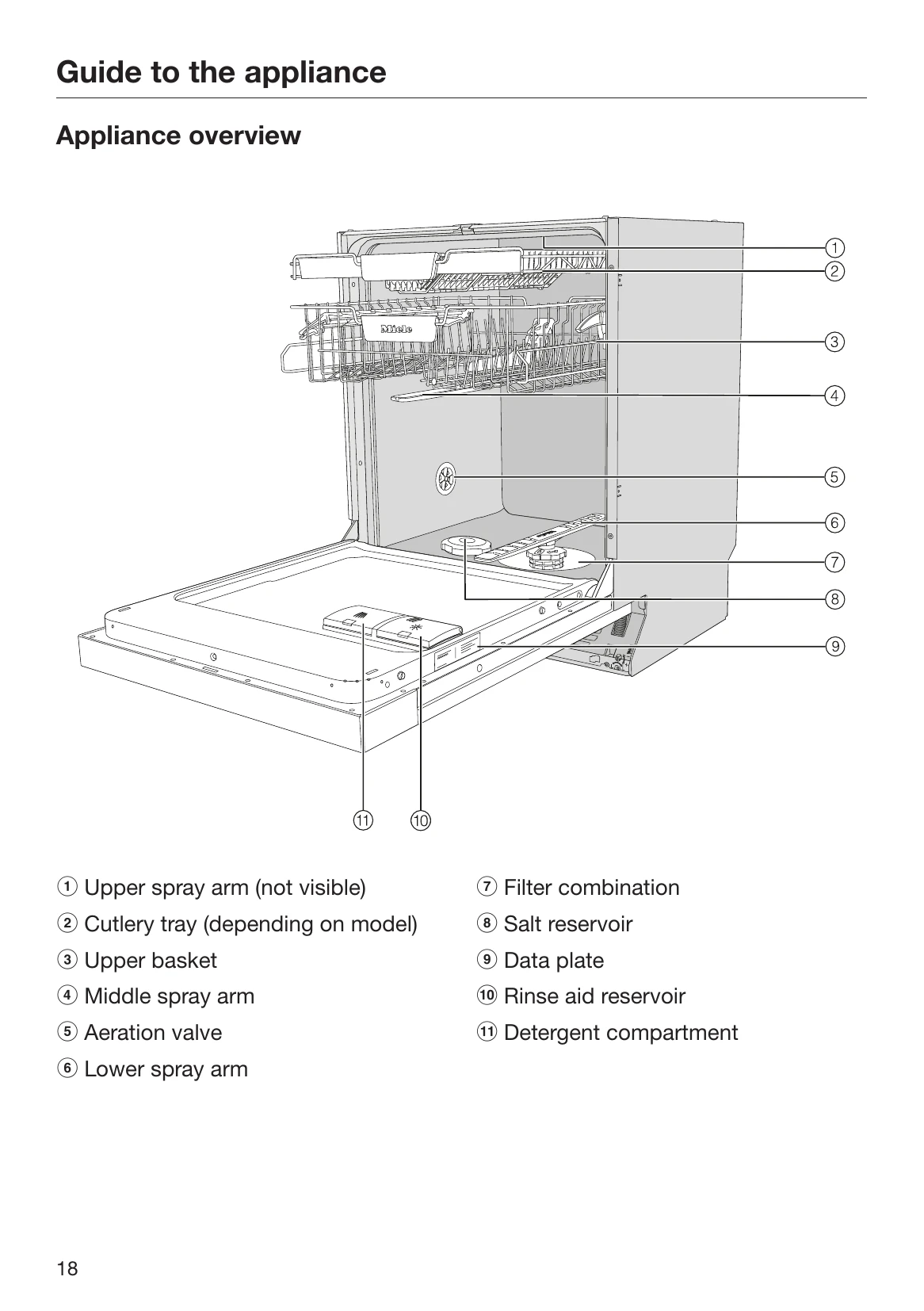
Before using the dishwasher for the first time, ensure it is correctly installed and connected. Familiarize yourself with the appliance overview and control panel. The dishwasher undergoes testing at the factory, so residual water may be present. Some programs feature an automatic door opening for drying; this can be deactivated if preferred. Always ensure the door is closed properly and that the safety lock is engaged to prevent accidental opening, especially by children. The dishwasher can be connected to cold or hot water, with hot water saving time and energy.

Loading the dishwasher

Proper loading is crucial for optimal cleaning. Utilize the upper and lower baskets, cutlery tray/basket, and the 3D MultiFlex tray as intended. Pay attention to the placement of items to ensure water and detergent can reach all surfaces. Refer to loading examples for guidance.

Detergents and Options

Use only Miele-specific detergents, rinse aid, and dishwasher salt for best results and to protect the appliance. Various program options are available to enhance cleaning performance, such as Extra clean and Extra dry. The timer function allows for delayed start.

Troubleshooting and error codes

Problem Possible cause and remedy
Dishes are not dry or cutlery and glasses are blotchy.
  • The amount of rinse aid may be insufficient, or the rinse aid reservoir is empty. Replenish the rinse aid, increase the dosage, or change the brand of rinse aid.
  • Dishes were taken out of the wash cabinet too soon. Leave dishes in longer.
  • The duration of the drying phase for the selected programme is not sufficient for the crockery (particularly for plastic crockery). Select the Extra dry programme option.
  • You have used combination products that have insufficient drying performance. Switch to another detergent or add rinse aid.
Glassware has a brown or blue tinge. The film cannot be wiped off.
  • Ingredients from the detergent have formed a deposit. Switch to another detergent straight away.
Glassware is dull and discoloured. The film cannot be wiped off.
  • The glassware is not dishwasher safe. The surface has altered. There is no remedy. Purchase glassware which is dishwasher safe.
Tea or lipstick stains have not been completely removed.
  • The wash temperature of the selected programme was too low. Select a programme with a higher wash temperature.
  • The bleaching effect of the detergent is too low. Change your detergent.
Plastic items are discoloured.
  • Natural dyes, e.g. from carrots, tomatoes or tomato sauce may be the cause. The amount of detergent used or its bleaching effect was not sufficient to deal with natural dyes. Use more detergent. Parts that are already discoloured will not revert to their original colour.
White residue is visible on the dishware. Clouding has occurred on glassware and cutlery. The film can be wiped off.
  • Not enough rinse aid was added. Increase the dosage.
  • The salt reservoir is empty. Fill the salt reservoir.
  • The salt reservoir cap has not been screwed on correctly. Replace it, making sure that it screws back on correctly.
  • Unsuitable combination detergents were used. Change your detergent. If using tabs or powder detergent, do not choose combination products and ensure you refill the reactivation salt and rinse aid.
  • The water softener is programmed to a setting which is too low for the water hardness level. Programme the water softener to a higher water hardness level.
There are rust stains on cutlery.
  • The affected items are not corrosion resistant. There is no remedy. Purchase cutlery which is dishwasher safe.
  • A programme was not run after dishwasher salt was added. Traces of salt have gotten into the normal wash cycle. Always run the 65 °C QuickPowerWash programme with the Express option selected and without any load in the dishwasher immediately after adding dishwasher salt.
  • The salt reservoir cap has not been screwed on correctly. Replace it, making sure that it screws back on correctly.
Privacy Policy