Brand: KENWOOD
Category: Other
Document Type: Manual
Language: EN
Brand: KENWOOD
Category: Other
Document Type: Manual
Language: EN
Uploaded: Nov. 21, 2025, 7:51 p.m.
Manual Publish Date: 91/12
None
1. Outline: The PR Series is a regulated DC power supply with constant voltage/constant current output, adjustable from 0 to rated values. It features calibrated meters for simultaneous voltage and current monitoring and high-precision variability via coarse and fine adjust knobs. Multiple units can be connected in parallel for increased current output in a master/slave configuration.
2. Features: Offers extremely low voltage/load fluctuations and ripple noise. Provides separate voltage and current meters, continuously adjustable output voltage/current, and overload/shorting protection via constant current circuit. Supports "one control" series or master/slave parallel operation. Optional rack mounting is available.
4. Precautions for Use: Ensure operation within the specified voltage range (100-240V AC +/- 10%) and ambient temperature (0-40 deg C). Avoid obstructing ventilation. For output terminals, ensure the MASTER/SLAVE switch is set to MASTER for ordinary use, and connect either the (+) or (-) terminal to GND via a shorting bar.
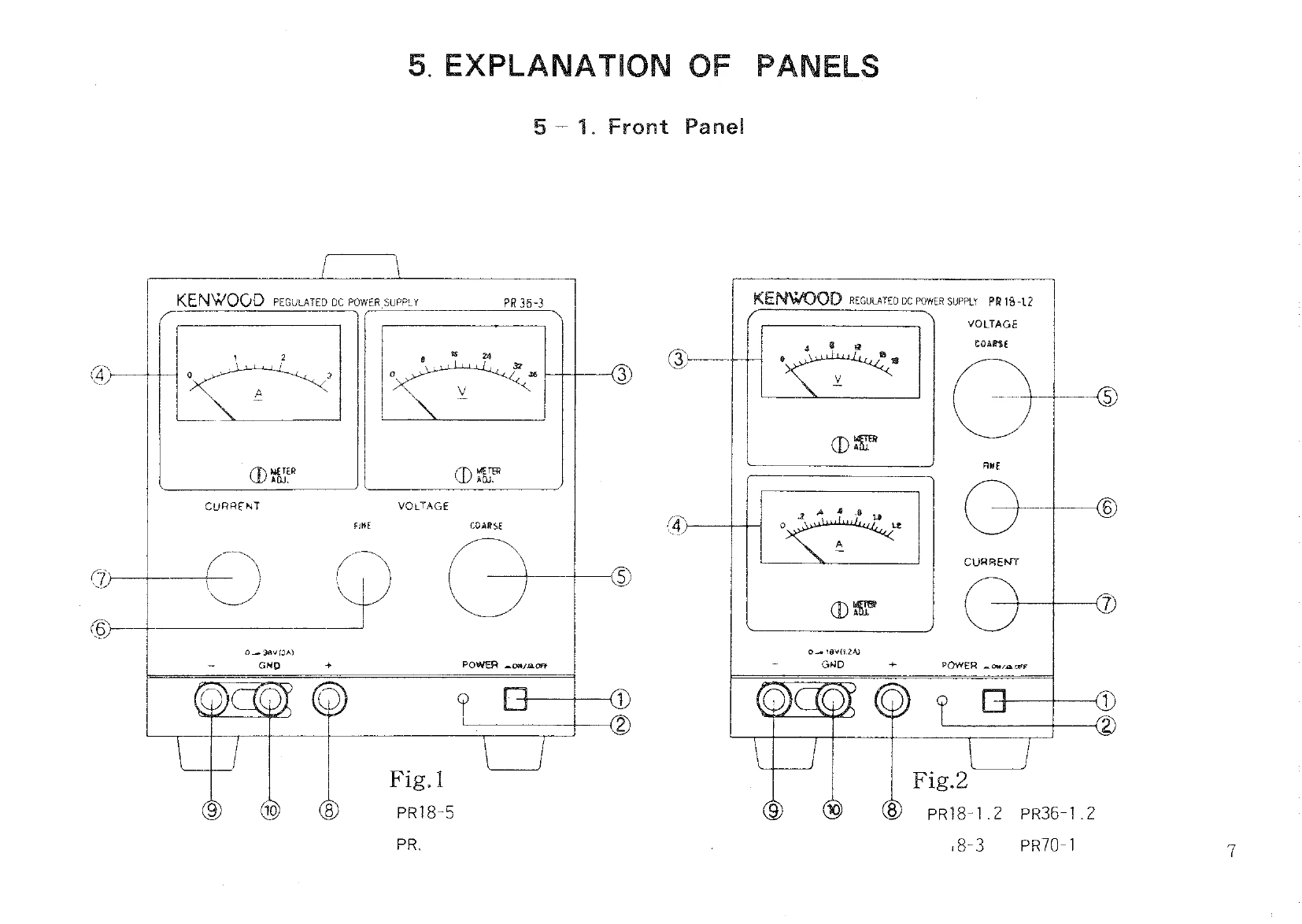
5. Explanation of Panels: Details the front panel components including POWER ON/OFF, POWER LED, Voltmeter, Ammeter, VOLTAGE COARSE/FINE adjust knobs, and CURRENT adjust knob. Also identifies output terminals (+), (-), and GND. The rear panel includes the MASTER/SLAVE switch, IN/OUT terminals for parallel operation, power cable, and heat sink.
6. Operation Procedures: Covers Stand Alone Operation (set MASTER/SLAVE to MASTER), Serial Connection (for increased output voltage, ensuring terminal voltages do not exceed ground proof voltage), and Parallel Operation (master/slave control for increased current capacity). Specific hook-up procedures and connection diagrams are provided for both serial and parallel configurations.
7. Maintenance: Includes instructions for removing the case, changing the rated source voltage by adjusting the internal power transformer and fuse specifications, and replacing fuses. A chart provides fuse ratings for different models and voltage settings.
8. Troubleshooting: A table lists common problems (e.g., power supply won't turn on, no output voltage/current, excessive/unstable output) with indicators to check, causes, and remedies.
| Problem | Indicators or Areas to check | Cause |
|---|---|---|
| Power supply will not go on. | Power ON lamp does not light up. |
*Poor connection of power cord, or broken wire * Bad power switch * Fuse meltdown |
| No output voltage. | Voltmeter does not move. | * Circuit malfunction |
| No output current. | Ammeter does not move. | * Circuit malfunction |
| Excessively large output. | Output voltmeter and ammeter readings do not decrease. |
* Bad power trasistor or control mechanism * Circuit malfunction |
| Unstable output. |
Input voltage is wrong. Machine is vibrating. Strong magnetic or electrical field nearby. |
* Operating outside the rated voltage range * Oscillations due to special load type * Remove from source of oscillations. |