Brand: KENWOOD
Category: Dishwasher
Document Type: Manual
Language: EN
Brand: KENWOOD
Category: Dishwasher
Document Type: Manual
Language: EN
Uploaded: Nov. 21, 2025, 6:15 p.m.
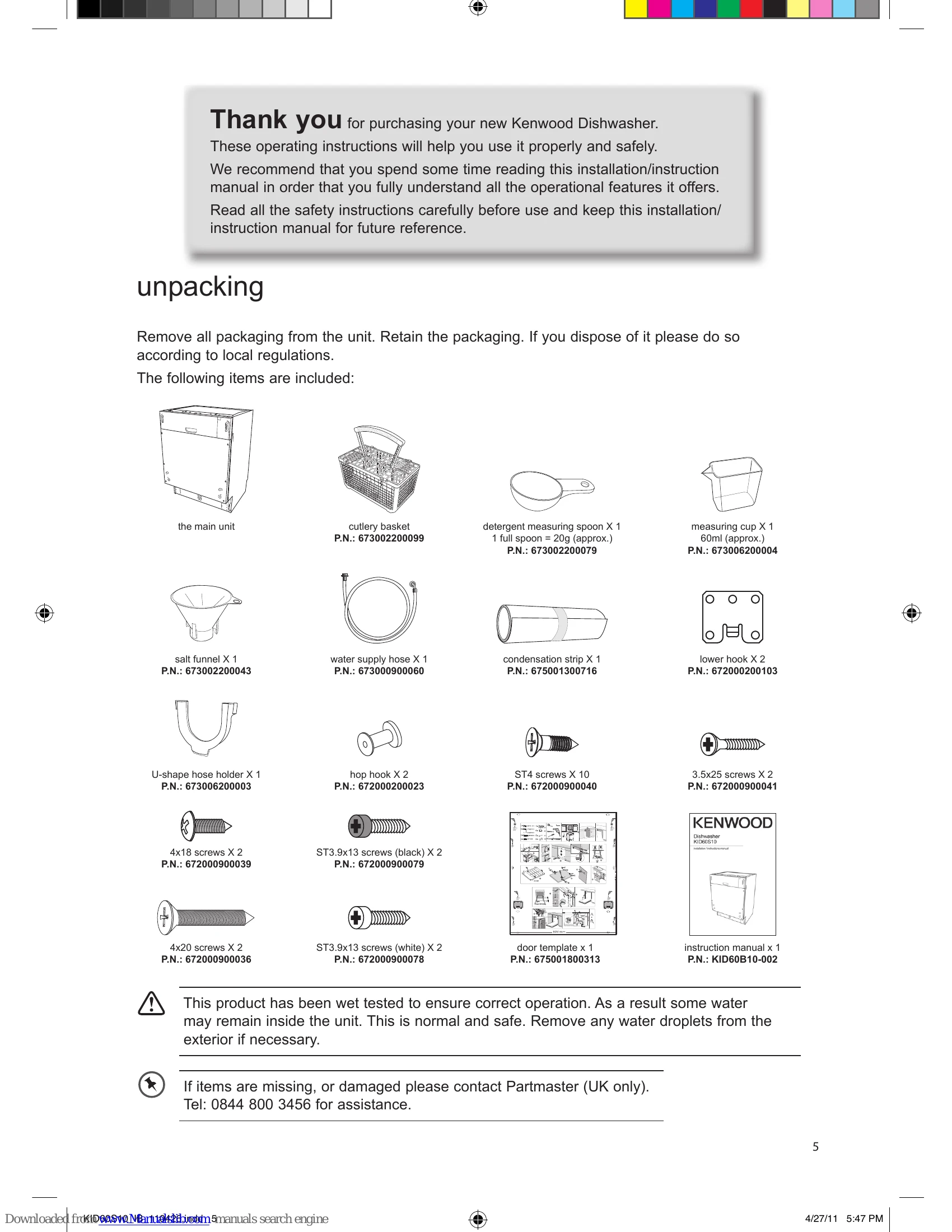
Contact Partmaster for missing or damaged items; DSG Retail Limited is responsible for after sales service.
| codes | possible causes | remedy |
|---|---|---|
| E1 | Water tap is not turned on. | Turn on the water tap. |
| E1 | Low water pressure (<0.04MPa) | Turn on the water tap and ensure it is in full position. |
| E1 | Flow meter is broken. | Disconnect from the mains socket. |
| E4 | The wire terminals which connect the flow meter are loose. | Disconnect the water inlet. |
| E4 | The tank is leaking. | Call a qualified technician. |
| E4 | The hose is leaking. | |
| E4 | The float switch is broken or PCB is faulty. |
| problem | possible causes | remedy |
|---|---|---|
| The dishwasher does not start. | The door is not properly closed. | Close the door firmly. |
| The dishwasher does not start. | The unit is not connected to the mains socket. | Connect the mains plug to the mains socket. |
| The dishwasher does not start. | The unit is not switched on. | Press the on/off button and select a programme. |
| The drain pump is not working properly. | Fault code E4 - The anti-flooding system has operated. | Disconnect from the mains socket. Disconnect the water inlet. Call a qualified technician. |
| problem | possible causes | remedy |
|---|---|---|
| Detergent residue is left in the dispenser at the end of the programme. | The detergent dispenser was still damp when detergent was added. | Make sure the dispenser is dry before adding detergent. |
| The detergent dispenser lid cannot be closed properly. | Clogged detergent residue is blocking the catch. | Clean the catch. |
| Knocking noise in the wash cabinet. | A spray arm is knocking against an item in a basket. | Interrupt the programme, and rearrange the items which are obstructing the spray arm. See the section "Loading the Dishwasher". |
| Smearing appears on glassware and cutlery. | The rinse aid dosage is set too high. | Adjust the dial of the rinse aid dispenser to a lower setting. |
| Dishes, cutlery and glasses are not dry. | The amount of rinse aid may be insufficient, or the rinse aid reservoir is almost empty. | Replenish the reservoir, adjust the rinse aid dispenser dial to a higher setting or change the brand of rinse aid. |
| Dishes, cutlery and glasses are not dry. | Crockery was taken out of the dishwasher too soon. | Leave the crockery in the dishwasher until you hear an audible sound. |
| Dishes, cutlery and glasses are not dry. | Not enough rinse aid was used. | Replenish the reservoir, adjust the rinse aid dispenser dial to a higher setting or change the brand of rinse aid. |
| White residue is visible on cutlery and crockery, clouding occurs on glassware; film can be wiped off. | There is not enough salt in the salt reservoir. | Fill the salt reservoir. |
| White residue is visible on cutlery and crockery, clouding occurs on glassware; film can be wiped off. | The salt reservoir cap has not been screwed on correctly. | Ensure that it is screwed back on correctly. |
| Glassware is dull and discoloured; film cannot be wiped off. | Unsuitable detergent has been used. | Change your detergent. Use a dishwasher standard powder detergent. |
| Glassware is dull and discoloured; film cannot be wiped off. | The salt consumption setting is too low. | Select a higher salt consumption setting. |
| Glassware is dull and discoloured; film cannot be wiped off. | The glassware is not dishwasher proof. The surfaces are affected. | Wash the non-dishwasher proof glassware by hand. |
| Tea or lipstick stains have not been completely removed. | The wash temperature of the selected programme was too low. | Select a programme with a higher wash temperature. |
| The bleaching effect of the detergent used is too low. | Change your detergent. | |
| Forgot to pre-rinse or remove the stains with a napkin prior to washing. | Pre-rinse or remove the stains with a napkin prior to washing. |