Manual for ENN26800

Manual for ENN26800

Brand: ELECTROLUX

Category: Refrigerator

Document Type: Manual

Language: EN
Uploaded: Nov. 21, 2025, 7:16 p.m.

Manual Publish Date: null

Warranty Information

null

\n
    \n
  • Safety Information: Read the manual carefully before installation and first use. Ensure all users are familiar with operation and safety features. Keep instructions with the appliance.
  • \n
  • Children and Vulnerable People Safety: Appliance not for use by persons with reduced capabilities unless supervised. Supervise children to ensure they do not play with the appliance. Keep packaging away. If discarding, pull the plug, cut the cable, and remove the door. Older appliances with spring locks should have them made unusable.
  • \n
  • General Safety: Keep ventilation openings clear. Appliance is for household food and beverage storage. Do not use artificial means for thawing. Do not use other electrical appliances inside unless approved. Do not damage the refrigerant circuit (R600a, flammable).
  • \n
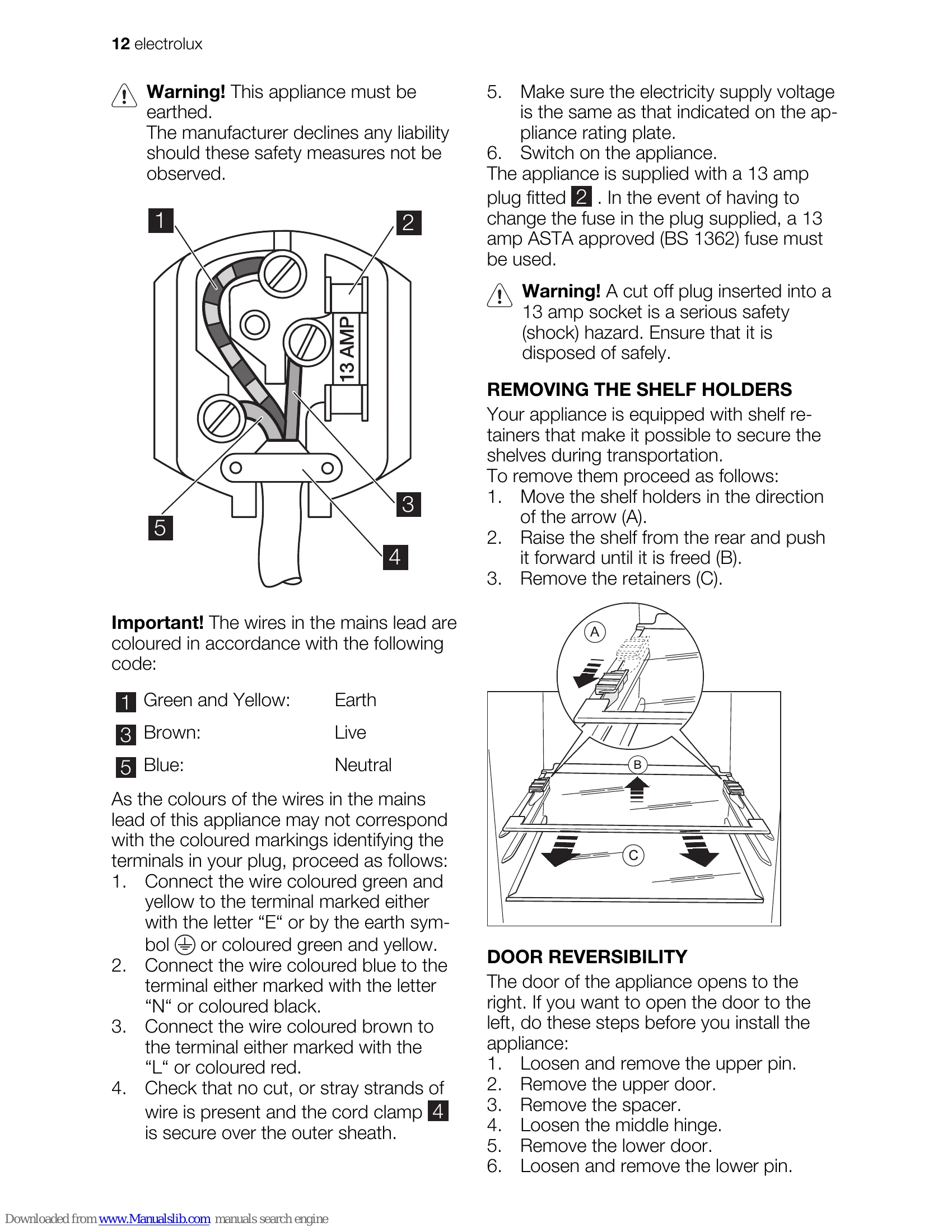
  • Electrical Safety: Do not alter specifications. Damaged cords can cause fire/shock. Electrical components must be replaced by a certified agent. Power cord must not be lengthened. Ensure plug is not squashed. Ensure mains plug is accessible. Do not pull the mains cable. If socket is loose, do not insert the plug. Operate with lamp cover if foreseen.
  • \n
  • Daily Use: Do not place hot pots on plastic parts. Do not store flammable gas/liquid. Do not place food directly against air outlet (Frost Free). Do not re-freeze thawed food. Store pre-packed food according to manufacturer instructions. Do not place carbonated drinks in freezer. Ice lollies can cause frost burns if consumed immediately.
  • \n
  • Care and Cleaning: Switch off and disconnect mains plug before maintenance. Do not use metal objects or sharp objects to remove frost. Use a plastic scraper. Regularly examine and clean the drain for defrosted water.
  • \n
  • Installation: Follow electrical connection instructions. Unpack and check for damage. Wait at least four hours before connecting. Ensure adequate air circulation. Position the back of the product against a wall if possible. Do not locate near radiators or cookers. Ensure mains plug is accessible. Connect to potable water supply only if foreseen.
  • \n
  • Control Panel: ON/OFF switch, temperature regulators for freezer and fridge, temperature indication button, display, Function button, Alarm reset switch.
  • \n
  • Functions: Action Freeze, Shopping Function. Normal operation is the default.
  • \n
  • Temperature Regulation: Fridge: +2°C to +8°C. Freezer: -15°C to -24°C. Recommended: +5°C in fridge, -18°C in freezer.
  • \n
  • Excessive Temperature Alarm: Indicated by flashing temperature, flashing freezer compartment indicator, red display illumination, and buzzer.
  • \n
  • First Use: Clean interior and accessories with lukewarm water and neutral soap.
  • \n
  • Freezing Fresh Food: Activate Action Freeze at least 24 hours before. Maximum freezing capacity is on the rating plate. Freezing process lasts 24 hours.
  • \n
  • Storage of Frozen Food: Allow appliance to run on Action Freeze for 24 hours before storing. Remove drawers/baskets for better performance with large quantities. Do not exceed load limits.
  • \n
  • Thawing: Thaw in refrigerator or at room temperature. Small pieces can be cooked frozen.
  • \n
  • Ice-Cube Production: Use supplied trays.
  • \n
  • Cold Accumulators: Increase storage time during power cuts.
  • \n
  • Movable Shelves: Adjustable for desired positioning.
  • \n
  • Energy Saving: Do not open door frequently. Set warmer settings if frost/ice forms.
  • \n
  • Fresh Food Refrigeration: Do not store warm food or evaporating liquids. Cover/wrap food. Ensure air circulation.
  • \n
  • Refrigeration Hints: Specific advice for meat, cooked foods, fruit/vegetables, butter/cheese, and milk bottles. Bananas, potatoes, onions, and garlic should not be kept in the refrigerator.
  • \n
  • Freezing Hints: Maximum quantity, freezing time, food quality, portioning, airtight packaging, avoid contact with frozen food, lean foods store better, water ices can cause burns, show freezing date.
  • \n
  • Storage of Frozen Food Hints: Ensure proper retailer storage, transfer quickly, don't open door frequently, defrosted food deteriorates rapidly, do not exceed manufacturer's storage period.
  • \n
  • Periodic Cleaning: Clean interior and accessories regularly with lukewarm water and neutral soap. Check door seals. Clean condenser and compressor.
  • \n
  • Defrosting the Refrigerator: Automatic defrosting.
  • \n
  • Defrosting of the Freezer: "No frost" type.
  • \n
  • Periods of Non-Operation: Disconnect, remove food, defrost, clean, leave doors ajar.
  • \n
  • What to do if...: Troubleshooting table for appliance not operating, lamp not working, compressor operates continually, water flows, temperature issues, frost.
  • \n
  • Replacing the Lamp: Instructions for safely replacing the bulb.
  • \n
  • Closing the Door: Clean gaskets, adjust door, replace defective gaskets if necessary.
  • \n
  • Technical Data: Dimensions, Rising Time, Voltage, Frequency.
  • \n
  • Installation: Climate class and ambient temperature. Electrical connection by qualified electrician. Positioning instructions. Door reversibility. Ventilation requirements. Attaching to niche.
  • \n
\n

Troubleshooting and error codes

Problem Possible cause Solution
The appliance does not operate. The lamp does not operate. The appliance is switched off. Switch on the appliance.
The mains plug is not connected to the mains socket correctly. Connect the mains plug to the mains socket correctly.
The appliance has no power. There is no voltage in the mains socket. Connect a different electrical appliance to the mains socket. Contact a qualified electrician.
The lamp does not work. The lamp is in stand-by. Close and open the door.
The lamp is defective. Refer to "Replacing the lamp".
The compressor operates continually. The temperature is not set correctly. Set a higher temperature.
The door is not closed correctly. Refer to "Closing the door".
Water flows on the rear plate of the refrigerator. The door has been opened too frequently. Do not keep the door open longer than necessary.
The product temperature is too high. Let the product temperature decrease to room temperature before storage.
The room temperature is too high. Decrease the room temperature.
During the automatic defrosting process, frost defrosts on the rear plate. This is correct.
Water flows into the refrigerator. The water outlet is clogged. Clean the water outlet.
Products prevent that water flows into the water collector. Make sure that products do not touch the rear plate.
Water flows on the ground. The melting water outlet does not flow in the evaporative tray above the compressor. Attach the melting water outlet to the evaporative tray.
The temperature in the appliance is too low. The temperature regulator is not set correctly. Set a higher temperature.
The temperature in the appliance is too high. The temperature regulator is not set correctly. Set a lower temperature.
The door is not closed correctly. Refer to "Closing the door".
The temperature in the refrigerator is too high. The product temperature is too high. Let the product temperature decrease to room temperature before storage.
Many products are stored at the same time. Store less products at the same time.
The temperature in the freezer is too high. There is no cold air circulation in the appliance. Make sure that there is cold air circulation in the appliance.
Products are too near to each other. Store products so that there is cold air circulation.
There is too much frost. Food is not wrapped correctly. Wrap the food correctly.
The door is not closed correctly. Refer to "Closing the door".
The temperature regulator is not set correctly. Set a higher temperature.
Privacy Policy