Manual for NAL/NALF

Manual for NAL/NALF

Brand: ABB

Category: Other

Document Type: Manual

Language: EN
Uploaded: April 20, 2026, 8:11 p.m.

Manual Publish Date: 2011-09-01

Warranty Information

ABB products come with a warranty, detailed in the manual, though specific periods are not universally stated.

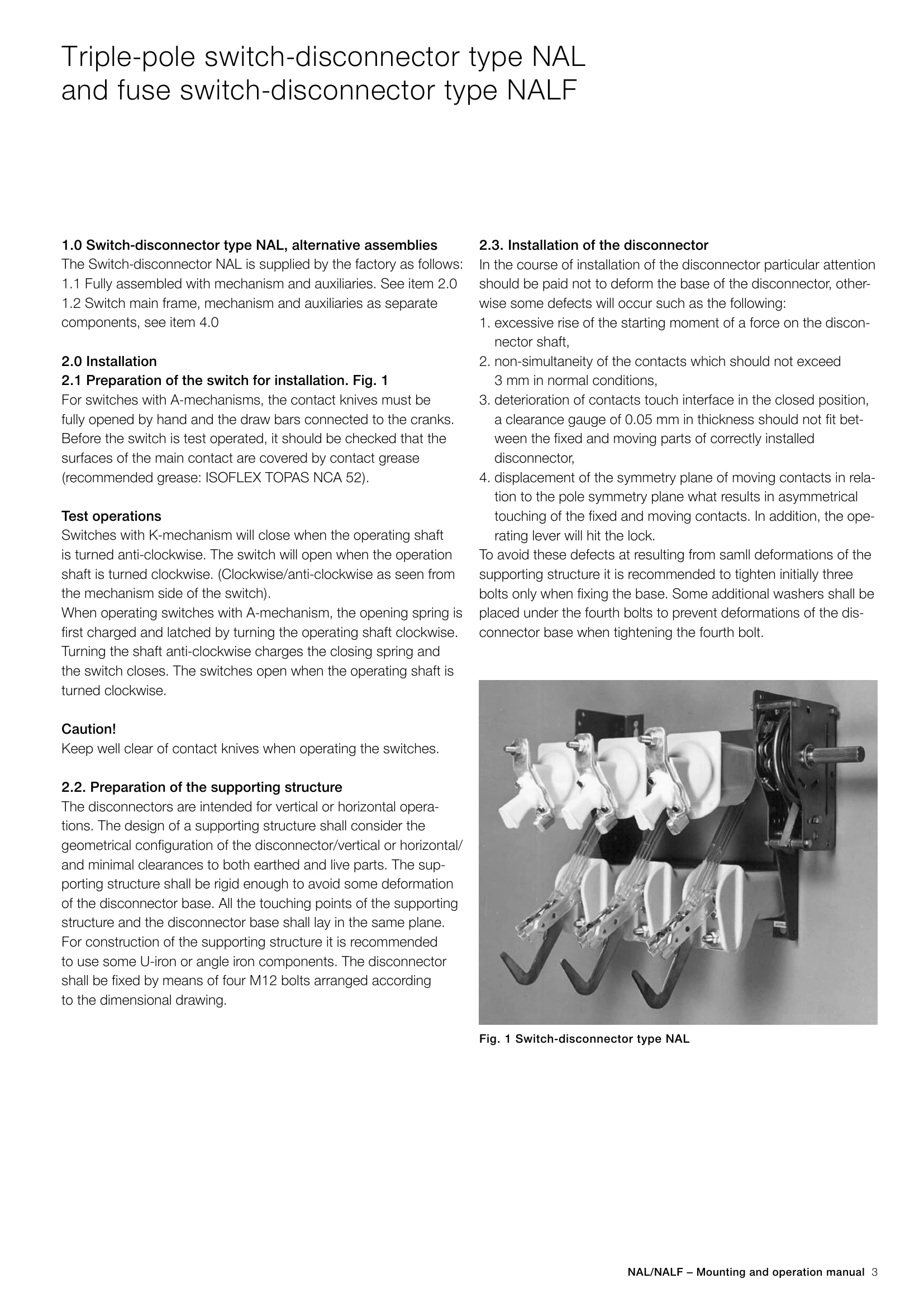
Introduction: The NAL/NALF switch-disconnector system is modular, featuring a frame with insulators and current carrying elements. It accommodates two types of operating mechanisms: snap action type K or stored spring energy type A. Fuse bases (type F) and earthing switches (type E/EB) can be added for complete configurations. Accessories like shunt trips, under-voltage releases, and auxiliary switches can be integrated. Main Areas of Application:
  • Line and transformer switches in distribution networks
  • Motor switches
  • Capacitor switches
Main Product Features: The NALF combines NAL load break capabilities with fuse bases for interrupting large short-circuit currents. It meets various international standards, including IEC, GOST, and CSA. The NAL version for the ANSI standard is called VersaRupter. Installation: Follow detailed instructions for mounting mechanisms, fuse bases, earth switches, and auxiliary components. Ensure correct alignment and lubrication where specified. Motor drives can also be installed. Service and Maintenance: Includes cleaning, checking operations, and scheduled overhauls. Specific greasing recommendations are provided for contacts. Arcing knives, pistons, and cylinders should not be greased. Overhaul frequency depends on operations and conditions. Replacement of Parts: Detailed procedures are provided for replacing components such as contact knives, fixed contacts, arcing chambers, insulators, draw bars, pistons, and piston rods. Technical Specifications: Details on main functions, including closing/opening speeds, operating torques, contact penetration, and alignment, are provided for different voltage ratings (12 kV, 17.5/24 kV, 36 kV). Environmental Declaration: Information on product life expectancy, recycling capability, and raw material breakdown is presented, along with ABB's commitment to environmental protection and end-of-life recycling.

Troubleshooting and error codes

Problem Cause Solution
Switch disconnector does not open after fuse interruption. Fuse link has not been replaced. Replace the fuse link.
Excessive rise of the starting moment of a force on the disconnector shaft. Deformation of the disconnector base. Ensure proper mounting and initial tightening of bolts. Use washers to prevent deformation.
Non-simultaneity of contacts exceeds 3 mm. Deformation of the disconnector base or improper installation. Ensure proper mounting and alignment.
Deterioration of contacts touch interface in the closed position. Improper installation or deformation. A clearance gauge of 0.05 mm should not fit between fixed and moving parts.
Displacement of the symmetry plane of moving contacts. Improper installation leading to asymmetrical touching. Ensure correct alignment of contacts.
Arcing knife does not have the same position related to the contact knife during closing and opening movement. Incorrect adjustment or wear. Check and adjust the eccentric bolt and support insulator.
Fuse switch disconnector does not open when adjusted. Incorrect adjustment of fuse tripping mechanism. Check and repeat the adjustment of the fuse tripping mechanism and distances.
Privacy Policy